
Discours - Visite de Courtoisie à Londres | 18/11/2026

Dear ministers,
Excellencies,
Ladies and Gentlemen,
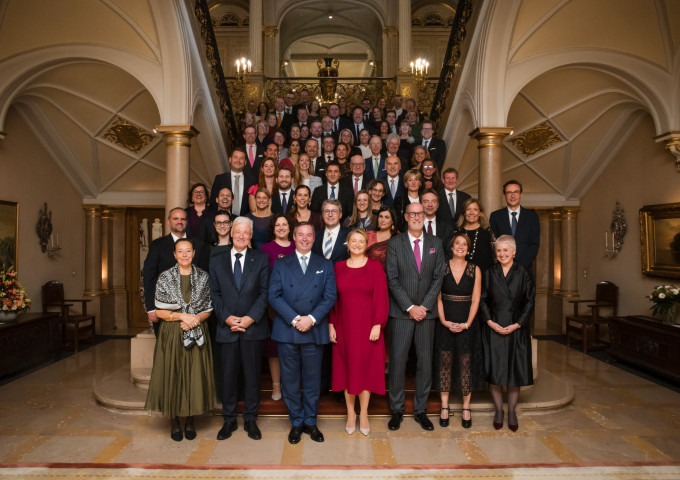
It is a great pleasure to be with you this evening, and a particular pleasure to be here, at 116 Pall Mall.
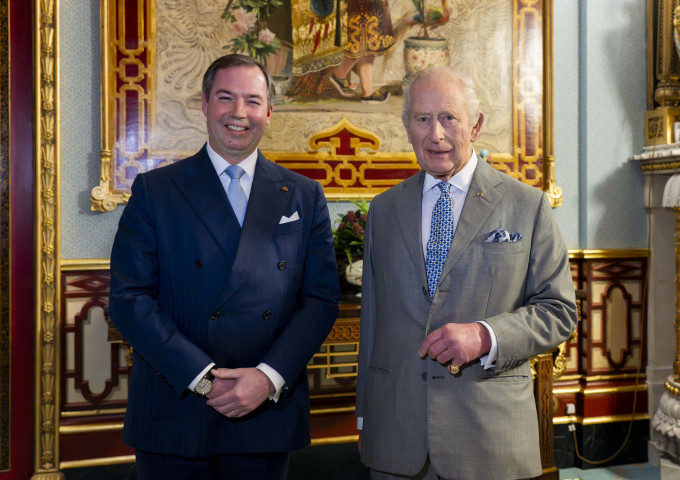
Earlier today I had the honour of being received by His Majesty The King. It was a warm and engaging meeting, and the latest chapter in a friendship between our families, and between our countries, that goes back a very long way.
This is my first visit to the United Kingdom since my accession, and I could hardly have wished for a more fitting setting.
As you came up the grand staircase this evening, you passed beneath a chandelier given by King George the Fourth to commemorate the victory at Waterloo. 1815 is a year that matters to Luxembourg, too. It was in that same year, at the Congress of Vienna, that Luxembourg became a Grand Duchy. So that chandelier and the country I represent began their stories in the very same summer.
Ladies and Gentlemen,
For me, this visit is also something of a homecoming. Like my father and my grandfather before me, I trained as an officer at Sandhurst. Years later, the Grand Duchess and I made our home here in London while I studied at the Royal College of Defence Studies. Like so many Luxembourgers, I came to know the openness, the energy and the humour of this country first-hand, and I have never lost my affection for it.
That affection is rooted in history.
Twice in the nineteenth century, the Treaties of London, in 1839 and 1867, secured Luxembourg's independence at moments when our very existence was in question.
And in 1940, when Luxembourg was occupied, it was to London that my great-grandmother, Grand Duchess Charlotte, came, together with our Government in exile. It was the BBC that gave her a voice to reach her people across occupied Europe. Those broadcasts brought hope, courage and unity to a nation deprived of its freedom. The voice that travelled from London to Luxembourg remains part of our national memory to this day.
During those dark times for Europe, her son, my grandfather, Grand Duke Jean, joined the Irish Guards. He landed in Normandy in 1944 and fought alongside British forces in the campaign to liberate Europe, and with it, his own country. He later became Colonel of the Regiment, and some of you may remember him riding behind Queen Elizabeth at the Trooping the Colour. Speaking in London in 1972, he said that Britain had "stood by Luxembourg whenever our most fundamental interests were at stake." Luxembourg will always be grateful to the British servicemen who helped to set us free.
And fifty years ago this very month, Queen Elizabeth paid a State Visit to Luxembourg, her first visit to a member of the European Community after Britain joined. Those who lined our streets in November 1976 still speak of it with great affection.
These are not merely chapters of history: they are part of who we are.
But, Ladies and Gentlemen,
The most important chapter of our relationship is not found in the history books. It is found and represented here in this room.
Today six thousand British nationals have made Luxembourg their home, working in our banks and insurers, our law firms, our start-ups and our institutions. And more than two and a half thousand Luxembourgers live here in the United Kingdom, building careers, businesses and families.
For decades, this country has been a favourite destination for young Luxembourgers who come to study. Many find not only an excellent education, but friendships that last a lifetime. Those numbers have fallen in recent years, and I very much hope we can reverse that. Tomorrow, at Imperial College, we will launch a new initiative allowing professionals in Luxembourg's financial centre to study and certify through Imperial: a step that builds talent for both London and Luxembourg.
Our cultural ties are just as lively. One of the very first cultural agreements Luxembourg signed after the war was with the United Kingdom, in 1950. Today Luxembourg artists appear across this country, from London to the Edinburgh Fringe, and I am delighted that some of them are with us tonight.
And then, of course, there is business. I will not bore you with statistics, except for one: Luxembourg is now the United Kingdom's largest export market for financial services in Europe and one of its largest worldwide. Our relationship has weathered the changes of recent years, and it continues to thrive.
That partnership now reaches well beyond finance: into fintech and sustainable finance, into space and, increasingly, into defence. British companies are choosing Luxembourg as their base for European operations, and Luxembourg is proud to serve as their gateway to the European market.
Ladies and Gentlemen,
Our friendship rests on something deeper than trade. It rests on shared values: democracy, the rule of law, and respect for the dignity of every individual.
For many decades, Luxembourg and the United Kingdom walked side by side within the European Union. Ten years ago, our institutional relationship changed. Our friendship and partnership did not. And in two days' time, leaders from the European Union and the United Kingdom will meet to take that partnership and friendship forward.
So allow me, as a friend, to say what the United Kingdom has given Europe. Your parliamentary tradition and your respect for law. Your diplomatic reach and your military strength, which have defended our continent more than once. Your pragmatism, and the financial depth of the City. Much of the single market itself bears a British signature.
And Europe, I believe, has given a great deal in return: markets, partners, talent, and a continent that , for all its arguments and challenges, has built a remarkable degree of stability, cooperation and prosperity.
Your own poet John Donne wrote that "no man is an island, entire of itself; every man is a piece of the continent, a part of the main." Britain is an island, of course. But it has never been apart from the continent's story, and the continent's story has never been complete without it.
Whether in security and defence, in competitiveness, in energy or in the fight against climate change, the challenges we face do not stop at borders. Neither should our ambition to meet them together.
So my message this evening is a simple one, from a small country that knows the value of a good friend.
Europe needs you.
Thank you.
En savoir plus
Options d’accessibilité
- Animations
- Interlignage
- Police dyslexie
Recherche